
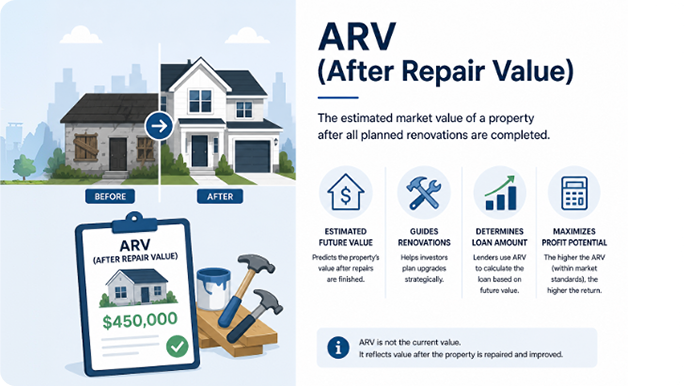
What is After Repair Value (ARV)?
After Repair Value (ARV) is the estimated market value of a property after all planned renovations or improvements have been completed.
ARV is commonly used by real estate investors, lenders, and appraisers to determine a property’s potential value once it is fully stabilized or updated.
Key Takeaways
- ARV represents the projected value of a property after repairs or renovations
- It is widely used in fix-and-flip and bridge loan underwriting
- ARV helps determine loan size, leverage, and profitability
- It is typically based on comparable sales (comps) of similar renovated properties
- ARV is an estimate—not a guaranteed future value
IMPORTANT
After Repair Value (ARV) is the estimated value of a property after all renovations are completed. It’s a critical metric real estate investors use to evaluate potential profit and make smarter investment decisions.
Understanding After Repair Value (ARV)
ARV plays a central role in real estate investment analysis, particularly in short-term investment strategies such as fix-and-flip projects.
Investors use ARV to evaluate whether a deal is financially viable by comparing:
- Purchase price
- Renovation costs
- Expected resale value
Lenders also rely on ARV to determine how much they are willing to lend on a project. In many cases, loan amounts are structured as a percentage of ARV rather than the current property value.
For example, a lender may offer financing up to 70%–75% of ARV, depending on the borrower profile and deal structure.
Note
While many real estate firms provide general ARV estimates, their accuracy often depends on outdated comps or surface-level analysis. At Brickline, we take a more strategic approach combining real-time market data, renovation scope, and local demand insights to deliver more precise and actionable ARV calculations that investors can actually rely on.
ARV Formula
ARV=Estimated Future Property Value After RepairsARV = Estimated\ Future\ Property\ Value\ After\ RepairsARV=Estimated Future Property Value After Repairs
In practice, ARV is not calculated using a strict formula. Instead, it is estimated using comparable sales data.
A more practical representation is:
ARV ≈ Value of similar renovated properties (comps)
How ARV is Calculated
ARV is typically determined using a comparative market analysis (CMA). This involves analyzing recently sold properties that are:
- Similar in size, layout, and location
- Recently renovated or in updated condition
- Sold within the last 3–6 months
Adjustments may be made for differences such as:
- Square footage
- Number of bedrooms and bathrooms
- Lot size
- Quality of renovations
In some cases, appraisers may also factor in market trends, demand shifts, or neighborhood growth.
Example of ARV
An investor identifies a property with the following characteristics:
- Purchase price: $200,000
- Renovation budget: $50,000
- Comparable renovated homes selling for: $350,000
Estimated ARV:
$350,000
This value is then used to:
- Determine maximum loan eligibility
- Estimate profit margins
- Evaluate risk
How Lenders Use ARV
In investment lending, ARV is often used to structure financing for renovation-based deals.
For example:
- A lender may offer up to 75% of ARV
- On a $350,000 ARV property → max loan ≈ $262,500
ARV is also used in underwriting constraints such as:
- Loan-to-After-Repair Value (LTARV)
- Risk thresholds for rehab-heavy projects
- Validation of renovation feasibility
If the total project cost (purchase + rehab) exceeds the ARV, the deal may be considered too risky.
Note
Lenders use ARV to determine how much they’re willing to finance, typically offering a percentage of the property’s projected post-repair value to manage risk and ensure loan security.
ARV vs. As-is Value
| Metric | Definition |
|---|---|
| As-Is Value | Current market value in its present condition |
| ARV | Estimated value after improvements are completed |
The difference between these tv,’0 values represents the value created through renovation.
Limitations of ARV
While ARV is a widely used metric, it has several limitations:
- Subjectivity: Depends on assumptions about comps and renovations
- Market volatility: Future market conditions may change
- Execution risk: Renovations may exceed budget or timeline
- Overestimation risk: Inflated ARV can lead to poor investment decisions
Because of these factors, ARV should be used alongside other metrics such as total project cost, cash flow projections, and risk analysis.
Why ARV Matters
ARV is one of the most important metrics in real estate investment because it directly impacts:
- Deal profitability
- Financing structure
- Risk assessment
- Exit strategy planning
For investors, ARV answers a simple but critical question:
“What will this property be worth when everything is done?”
Note
ARV helps investors estimate potential profit, set the right purchase price, and avoid overpaying for a property in competitive markets.